

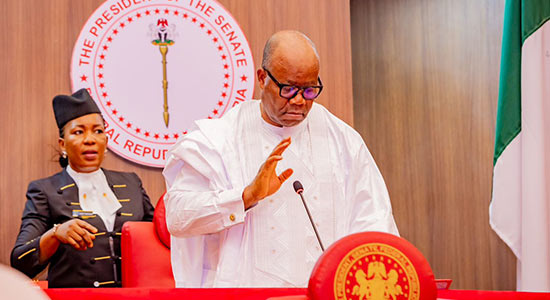
Senate President Godswill Akpabio has said the Senate will not bow to pressure or intimidation as it works toward producing an Electoral Act that strengthens Nigeria’s democratic process.
Akpabio made the remarks on Saturday in Abuja at the public presentation of *The Burden of Legislators in Nigeria*, a book authored by Senator Effiong Bob, and held at the Nigerian Air Force (NAF) Centre.
Addressing public criticism surrounding the proposed amendment to Section 60(3) of the Electoral Act, the Senate President described the controversy as premature, noting that the legislative process had not yet been concluded.
According to him, the Senate had neither adopted the votes and proceedings nor completed harmonisation on the bill.
“We have not passed the votes and proceedings; there is still harmonisation, but people are already on television sitting on panels abusing the Senate for something that is yet to be completed,” Akpabio said.
He stressed that senators retain the right to propose amendments until the votes and proceedings are approved.
“We can amend anything before we approve votes and proceedings. Why abuse the Senate when what we have is incomplete?” he asked.
In an apparent response to televised comments by the Chief Executive of the Policy and Legal Advocacy Centre (PLAC), Clement Nwankwo, Akpabio said the Senate would not legislate under pressure from civil society groups.
“We will not be intimidated but will do what is right for Nigeria and not that of one NGO. Retreats are not lawmaking,” he said.
Akpabio further explained that the Senate’s decision during plenary was limited to removing the phrase “real-time” from the provision to allow the Independent National Electoral Commission (INEC) the discretion to determine the mode of results transmission.
“If you make it mandatory and there is failure of system, there will be catastrophe,” he warned, adding that technical realities such as network failures, power outages, and grid collapse could disenfranchise parts of the country.
“Real-time means there will be no election results in nine states where there is no network, or anywhere there is a grid breakdown. Technology must save democracy, not endanger it,” he said.
He noted that the amendment process remains open, with room for further adjustments through the conference committee before final passage.
Earlier, while reflecting on the theme of Senator Bob’s book, Akpabio said Nigerian legislators operate under intense pressure, bearing the burden of representation, oversight, and budgetary control, all of which are constitutional responsibilities.
Former Senate President David Mark, who chaired the event, described the role of legislators as complex and demanding, noting that lawmakers face pressure not only from constituents but also from other arms of government.
Mark added that public misunderstanding often leads citizens to expect legislators to perform executive functions, such as building roads, schools, and hospitals, alongside their legislative duties.
He, however, urged Akpabio and members of the Senate to heed public demands and “do the right thing” regarding the Electoral Act.
Dignitaries at the event included Akwa Ibom State Governor, Pastor Umo Enoh; Chief of Staff to the President, Femi Gbajabiamila; and former senators Lee Maeba and Bassey Ewa-Henshaw, among others.


