

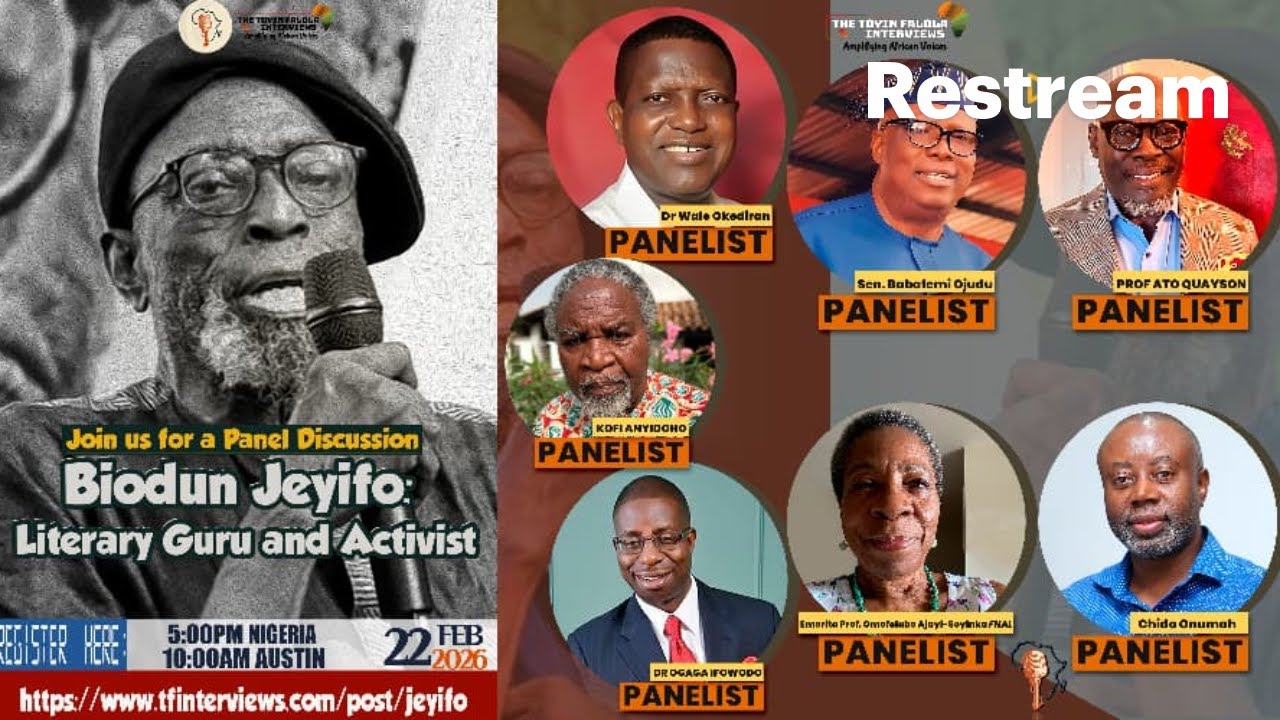
Leading scholars, writers and activists from across Africa, Europe, Asia and the Americas have affirmed that the enduring significance of the late Nigerian intellectual, Biodun Jeyifo, lies in his lifelong effort to connect scholarship with the struggle for human dignity and social transformation.
The consensus emerged at the February 23 session of the Toyin Falola Interviews, chaired by eminent historian Toyin Falola and streamed live to more than 9.6 million participants from over 26 countries.
Framing the gathering as part of a tradition of honouring major African thinkers, Falola said the platform had previously celebrated figures such as Ama Ata Aidoo, Ngũgĩ wa Thiong’o and Bethwell Ogot
“This is to celebrate our iconic figures,” Falola said. “On behalf of all the panellists and the viewers of this programme, I send condolence to the family. It is a great loss and we are here to honour Professor Biodun Jeyifo.”
He described Jeyifo as a scholar whose intellectual influence cut across disciplines and continents. While widely known for his radical commitments, Falola stressed that his scholarly interventions were equally transformative.
“Some people would appreciate Biodun Jeyifo for his radicalism; he was a columnist, writing a weekly column labelled Talakawa,” he said, recalling how the essays were later compiled and published internationally and in Nigeria.
Falola noted that Jeyifo’s work stood out for its ability to bridge indigenous cultural knowledge and global theory. “You could see how he was able to connect Yoruba cultural imagination to the bigger project of global theoretical formulations,” he said.
In later years, Falola added, Jeyifo’s work engaged extensively with Wole Soyinka, myth studies and debates about the African condition, including his formulation of the concept of “arrested development.”
“In my tribute, I said he has to be rated among the world’s best postcolonial theorists,” Falola said. “His career spanned three continents… As scholars, we have a scholarly community where we see ourselves as a family, living in different ecosystems.”
For media scholar and activist Chido Onumah, the most enduring lesson of Jeyifo’s life was the inseparability of scholarship and social struggle.
“Very few scholars can connect their scholarship and the quest for human liberation the way Biodun Jeyifo did,” Onumah said. “Those of us who read his Talakawa liberation column understand what that meant.”

He added that much of Jeyifo’s activist work remained undocumented, noting his participation in major democratic struggles, including the 1978 “Ali Must Go” protests and other efforts aimed at building “a more egalitarian society.”
Poet, lawyer and academic Ogaga Ifowodo described Jeyifo as “a renaissance man, a man of many parts whose abilities knew no bounds.”
“One word describes Biodun Jeyifo and that is rigour,” Ifowodo said. “At Cornell, it was said that because of his approach to work, there were always more angles to probe. He always invented other ways to look at the same problem.”
He recounted how a single question from Jeyifo during his doctoral candidacy examination forced him to rethink his theoretical framework and ultimately reshaped his research trajectory.
“That question set me on the path that eventually led to my successful dissertation,” he said.
Beyond intellectual toughness, Ifowodo emphasized Jeyifo’s intellectual humility. “He was never an ossified Marxist. He became his own fiercest critic, willing to correct the blindnesses that attended his earlier positions.”
He added that despite his demanding standards, Jeyifo remained deeply humane. “No matter how difficult the situation, he kept hope alive. His example to present scholars is never to lose sight of the humanising element of the arts and humanities.”
Emerita professor Omofolabo Ajayi-Soyinka described the global virtual gathering as both an intellectual tribute and a communal act of mourning.
“The ritual gathering for whatever purpose is powerfully cathartic. This one for a respected and beloved friend is momentous,” she said.
Reflecting on more than 50 years of acquaintance, she described Jeyifo as “scholar, teacher and activist—all integrated into one person,” with activism that remained grounded in Marxist ideals but attentive to lived realities.
“He was relentless in his quest for a more equitable and less corrupt Nigeria,” she said, highlighting his foundational role in the Academic Staff Union of Universities and his defence of university autonomy during periods of military rule.
Writer and former legislator Wale Okediran illustrated Jeyifo’s activist instincts through personal experience, recalling how he helped mobilise transportation and media support to secure the release of a detained lecturer.
“He had the nose for identifying people who had the capacity to move the frontiers of activism,” Okediran said. “He was always ready to help with resources.”
He added that Jeyifo maintained close ties with writers and activists during the political crisis surrounding Ken Saro-Wiwa and remained committed to mentoring younger generations across professions.
“He was an amazing character,” Okediran said. “He married the town and the gown.”
Former journalist and senator Babafemi Ojudu said Jeyifo’s greatest influence lay in cultivating independent thinking rather than ideological conformity.
“He never consciously tried to make anyone a Marxist,” Ojudu said. “He would open your mind to what your society is and what it ought to be. He never tried to spoon-feed his students.”
According to him, many of Jeyifo’s former students went on to become influential journalists, editors and public intellectuals because “we saw an example in him.”


